Root Canal vs. Dental Implant
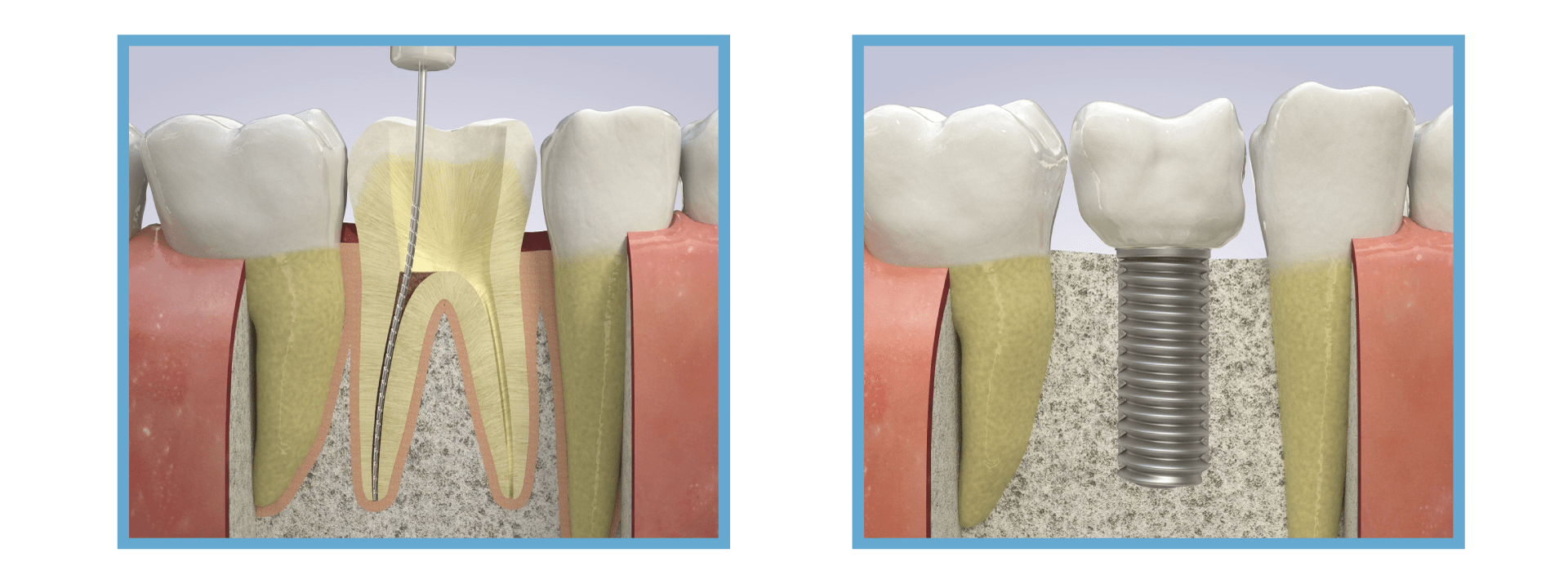
No replacement, however advanced, quite matches the tooth you were born with. That is why Dr. Raffi looks first at whether your tooth can be saved. At Dr. Raffi General & Implant Dentistry, a root canal can rescue a damaged or infected tooth and let it keep working like any other, often for the rest of your life. When a tooth genuinely cannot be saved, a dental implant steps in as an excellent replacement. Here is how the two options stack up.

Root canal
This is the tooth-saving option. The infected pulp is removed, the canals are cleaned and sealed, and a crown is placed on top, leaving your natural tooth in place and working normally.
Dental implant
When a tooth is beyond saving, it is extracted first. A titanium post then goes into the jawbone in its place, topped with a custom crown to complete the replacement.
Our approach
Your natural tooth is always worth saving first. Before Dr. Raffi ever recommends extraction and an implant, root canal therapy is considered as a way to preserve the tooth.
Torn between saving and replacing your tooth? We'll lay out your options so the choice is clear.
How They Compare
Saving Your Tooth With a Root Canal
- Preserves your natural tooth: Nothing looks, feels, or functions as well as the tooth you were born with
- Single procedure: Root canal + crown is typically completed in 1–2 visits
- High success rate: Over 95% of root canal-treated teeth last many years, often a lifetime
- No surgery: Non-surgical, performed under local anesthesia in the dental chair
- Maintains bone and gum: Keeping your natural tooth root preserves the surrounding bone and tissue
- Lower cost: Root canal therapy is generally less expensive than extraction + implant
Replacing Your Tooth With a Dental Implant
- Replaces a missing tooth: Excellent option when a tooth is too damaged to save
- Multiple procedures: Requires extraction, healing, implant surgery, more healing, and finally a crown. The full process typically takes 3–6+ months
- Durable result: Implants are long-lasting and can function for decades with proper care
- Surgical procedure: Requires oral surgery, bone grafting in some cases, and longer recovery
- Bone integration: The titanium post bonds with the jawbone, providing a stable anchor
- Higher cost: Extraction + implant + crown is typically more expensive than root canal + crown
Key Factors in Your Decision
When Root Canal Is the Better Choice
- The tooth still has enough structure to support a crown
- The infection or damage is limited to the pulp, while the outer tooth remains largely intact
- You want to preserve your natural bite, appearance, and chewing ability
- You prefer a less invasive procedure with a shorter recovery
- The tooth has strategic importance (supporting a bridge, maintaining spacing)
- Learn more about root canal therapy at our office
When an Implant May Be Necessary
- The tooth is too severely cracked, fractured, or decayed to restore
- Previous root canal treatment and retreatment have not resolved the infection
- A vertical root fracture has compromised the tooth's structural integrity
- The tooth has insufficient remaining structure to support a crown
- Learn more about dental implants as a replacement option
In most cases your natural tooth is worth saving. Let us examine it and help you decide.
What to Expect at Your Consultation
Visit Steps
- Evaluation: Dr. Raffi examines the tooth, reviews digital X-rays, and assesses the damage or infection
- Diagnosis: You'll receive a clear explanation of whether the tooth can be saved with root canal therapy or needs extraction
- Treatment options: We discuss the pros, cons, costs, and timeline for each option
- Collaborative care: If an implant is recommended, Dr. Raffi works with your general dentist or oral surgeon to coordinate your care
- Your choice: We believe in informed consent, so the final decision is always yours
Helpful Tips
- Ask Dr. Raffi if your tooth can be saved before agreeing to extraction
- If another dentist has recommended extraction, a second opinion from an endodontist can confirm whether the tooth is truly beyond saving
- Consider the full cost: extraction + implant + crown adds up to significantly more than root canal + crown in most cases
- Root canal-treated teeth can last a lifetime with a proper crown and good oral hygiene
- There's no rush to decide. Get all the information you need to feel confident
Frequently Asked Questions
In almost every case, saving your natural tooth is the better path. A natural tooth sits in a ligament that cushions biting forces and sends sensory feedback to your brain, and its root keeps the surrounding bone and gum tissue healthy. No implant can fully reproduce those functions.
Root canal therapy has a success rate over 95% and is less invasive, less expensive, and quicker than the full implant process. An implant is an excellent option when a tooth truly cannot be saved, but it remains a replacement rather than a match for the original.
With a proper crown to protect it and good day-to-day oral hygiene, a root canal-treated tooth can last a lifetime. The treatment clears the infection while leaving your natural tooth structure and root in place.
Studies show these teeth have long-term survival rates comparable to dental implants, and they achieve that without any surgery. Keeping up with regular checkups helps the restored tooth stay strong for years to come.
The full dental implant process typically runs three to six months or longer. It moves through several stages: extraction, a period of healing, implant surgery, another healing phase for osseointegration, and finally placement of the crown.
Some cases also call for bone grafting to rebuild the site, which adds further healing time. By contrast, a root canal and crown are usually completed in one or two visits, which is part of why saving the tooth is often the simpler route.
Modern root canal therapy is performed under local anesthesia and is generally no more uncomfortable than having a filling placed. The procedure actually relieves the pain caused by the infected nerve rather than creating it.
Most patients feel little during treatment, and any soreness afterward tends to fade within a few days. You can read more on our root canals page.
Yes. Trying to save your tooth first never closes off the implant option. If a root canal does not fully resolve the problem, retreatment can often address what the first attempt missed.
And if those efforts are eventually exhausted, the tooth can still be extracted and replaced with an implant. Starting with the least invasive option simply gives your natural tooth its best chance before moving on.
Yes. A root canal plus a crown is typically much less expensive than extraction, an implant, and a crown combined. The exact figures depend on the tooth, the complexity of the case, and your insurance coverage.
At our Chicago and Bourbonnais, IL offices, we lay out clear cost estimates for both options before treatment begins, and our financing page covers the payment plans available to you.
Give your natural tooth a fighting chance. Book an evaluation and find out whether it can be saved.
Related Topics
Visit Dr. Raffi General & Implant Dentistry
Chicago Office
6215 W Touhy Ave
Chicago, IL 60646
Bourbonnais Office
876 N Convent St
Bourbonnais, IL 60914