Implant Bridge in Chicago, IL
Losing several teeth in a row calls for more than a patch. An implant-supported bridge is one of the most effective ways to bring back your smile, your bite, and your confidence at the same time. Rather than leaning on the adjacent teeth the way a traditional bridge does, an implant bridge anchors straight into the jawbone, preserving bone, protecting the teeth around it, and delivering a permanent, natural-looking result. Dr. Raffi builds a custom treatment plan at Dr. Raffi General & Implant Dentistry to replace your missing teeth and restore full function.
What it is
Instead of resting on natural teeth, this bridge is anchored by two or more dental implants. It bridges a gap of three or more missing teeth in a row, and because it is fixed in place, it never comes out.
Who it's for
It works well for patients who have lost several teeth in a row and want something stable and permanent. The implants preserve bone and let the healthy teeth on either side of the gap stay exactly as they are.
How we help
We guide implant placement with precise digital imaging, craft the bridge to match your natural teeth, and shape the whole plan around your specific case.
Missing teeth shouldn't set the terms. An implant bridge brings your smile back for good.
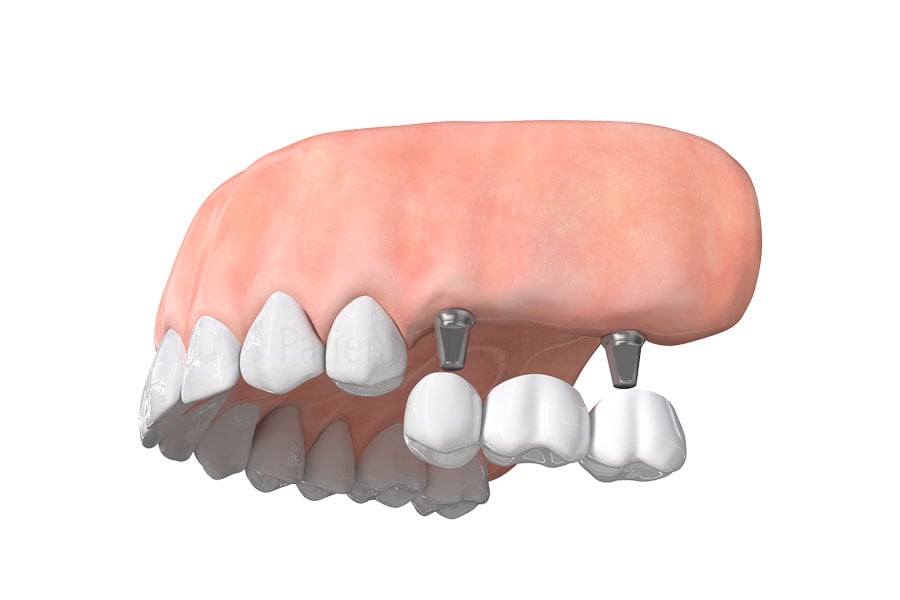
How an Implant Bridge Works
- Two or more titanium implants are placed into the jawbone to serve as anchors
- A custom bridge of connected porcelain crowns attaches to the implants
- The bridge replaces three or more missing teeth in a single, fixed restoration
- Unlike traditional bridges, no healthy teeth need to be filed down or crowned
- The implants stimulate the jawbone, preventing the bone loss that occurs with missing teeth
- Results look, feel, and function like your natural teeth

Why Replace Missing Teeth Now?
- Bone loss accelerates: Without tooth roots, the jawbone begins to resorb and shrink rapidly
- Teeth shift: Surrounding teeth move into the open spaces, causing misalignment and bite problems
- Remaining teeth are at risk: The teeth that compensate for the missing ones bear extra stress and may also be lost
- Chewing becomes difficult: Missing teeth reduce your ability to eat a full range of foods
- Facial changes: Bone loss can lead to a sunken, aged appearance around the jaw
- The sooner you act, the simpler and more affordable treatment will be
Advantages of an Implant Bridge
- Beautiful, natural appearance: Custom-crafted porcelain crowns that match your existing teeth perfectly
- Eat any food: Implant bridges are permanently fixed, so you can eat, bite, and chew with full confidence
- No shifting or moving: Anchored directly to the jawbone for rock-solid stability
- Preserves bone: Implants stimulate the jawbone, preventing the deterioration that comes with tooth loss
- Protects adjacent teeth: Unlike traditional bridges, there's no grinding down of healthy neighboring teeth
- Long-lasting: With proper care, implant bridges can last decades
The Treatment Process
- Consultation: Dr. Raffi evaluates your teeth and jawbone with digital X-rays and CT scans
- Treatment plan: A personalized plan is created based on the number of missing teeth and available bone
- Implant placement: Titanium posts are surgically placed into the jawbone under local anesthesia
- Healing period: The implants fuse with the bone over 3–6 months (osseointegration)
- Bridge fabrication: Custom porcelain crowns are designed and connected to form your bridge
- Final placement: The bridge is permanently attached to the implants, completing your new teeth
Replace a row of missing teeth without grinding down the healthy ones. Book a consultation today.
What to Expect at Your Visit
Visit Steps
- Evaluation: Dr. Raffi examines your mouth, reviews imaging, and discusses your goals and options
- Custom plan: You receive a detailed treatment plan with timeline, cost, and what to expect at each stage
- Surgery: Implants are placed in a comfortable office setting, with sedation options available
- Progress checks: Regular follow-up visits monitor healing and ensure everything is on track
- Final restoration: Once healed, your custom bridge is permanently attached
Helpful Tips
- If significant bone loss has occurred, bone grafting may be needed before implant placement
- Follow all post-surgical instructions carefully to support healing
- Stick to soft foods for the first few days after implant surgery
- Maintain excellent oral hygiene around the implant bridge by brushing and flossing daily
- Attend all scheduled follow-up appointments
- With proper care, your implant bridge can last for many years
Frequently Asked Questions
A span of three to four missing teeth can often be supported by just two implants placed at either end, with the bridge suspended between them. Longer gaps may call for one or more additional implants to spread the chewing load evenly.
The right number comes down to your jawbone density, where the gap sits, and how many teeth are being replaced. Dr. Raffi determines the ideal count after reviewing your imaging so your implant bridge is fully supported.
For most patients, yes. An implant bridge stands on its own implants, so the healthy teeth beside the gap are never filed down to serve as anchors. It also keeps the jawbone stimulated, which helps prevent the bone loss that follows missing teeth.
A traditional bridge leans on those neighboring teeth for support and can strain them over the years. Implant bridges also tend to last considerably longer, which makes them a sound long-term investment.
From the first implant placement to the final bridge, treatment generally runs four to eight months. The bulk of that time is healing, allowing the implants to fuse securely with the jawbone before the bridge is attached.
If bone grafting is required to rebuild the site first, add roughly three to six months for the graft to mature before the implants go in. Dr. Raffi gives you a stage-by-stage timeline at your consultation.
Not having enough bone today does not mean an implant bridge is off the table. During your consultation Dr. Raffi measures your bone density, and if it falls short, bone grafting can rebuild the ridge to create a solid foundation.
Grafting is a common, well-established step, and once the new bone has matured the implants can be placed as planned. It simply adds a stage to the timeline rather than ruling out treatment.
The cost of an implant bridge varies with the number of implants involved, whether bone grafting is needed, and how complex the bridge itself is. A short span supported by two implants is a different investment than a longer, multi-implant restoration.
At our Chicago and Bourbonnais, IL offices, we walk you through a detailed estimate during your consultation and offer flexible financing options to keep treatment affordable.
Caring for an implant bridge is much like caring for natural teeth. Brush twice a day, floss daily including underneath the bridge (a floss threader or water flosser makes this easy), and keep up with your regular checkups and cleanings.
That routine keeps the gum tissue and the implants beneath the bridge healthy. With consistent maintenance, an implant bridge can last for decades.
Bring back your smile and your confidence. Request your implant bridge consultation today.
Visit Dr. Raffi General & Implant Dentistry
Chicago Office
6215 W Touhy Ave
Chicago, IL 60646
Bourbonnais Office
876 N Convent St
Bourbonnais, IL 60914