Cracked Teeth in Chicago, IL
Few dental problems are as slippery to diagnose as a cracked tooth. The pain tends to flare and fade, and the crack itself is often invisible to the naked eye. At Dr. Raffi General & Implant Dentistry, Dr. Raffi focuses on tracking down and treating cracked teeth, using advanced imaging and magnification to pinpoint exactly where the fracture sits and how serious it is. Catching it early is what saves the tooth and stops the crack from spreading.

What it is
A fracture in a tooth, anywhere from a harmless surface crack to a deep split reaching into the root. Some appear suddenly after trauma; others build slowly from years of grinding and wear.
Who it's for
Anyone with on-and-off pain when chewing, temperature sensitivity, or unexplained discomfort in a tooth, most often in the back teeth where cracks tend to form.
How we help
Careful diagnosis using magnification, transillumination, and digital imaging to locate the crack, followed by targeted treatment aimed at saving the tooth whenever possible.
A cracked tooth never heals itself and can worsen fast. Call us for an evaluation before the crack spreads.
How to Tell If Your Tooth Is Cracked
- Sharp pain when biting that disappears when you release
- Pain that comes and goes with no obvious pattern
- Sensitivity to hot, cold, or sweet foods and drinks
- Discomfort when eating but you can't identify which tooth
- Swelling in the gum near the affected tooth
- Cracks most often appear in back teeth (molars and premolars)
Common Causes
- Teeth grinding (bruxism): Chronic clenching and grinding weaken enamel over time
- Biting hard objects: Ice, unpopped popcorn kernels, hard candy, and pens
- Large fillings: Teeth with extensive fillings have less structure and are more prone to cracking
- Trauma: Falls, sports injuries, or accidents
- Temperature extremes: Eating hot food followed immediately by ice-cold drinks
- Age: Teeth become more brittle over time, so cracks are most common after age 50
Types of Cracks
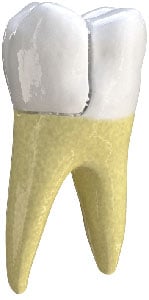
Fractured Cusp
This type of crack occurs when a portion of the tooth's cusp splits or breaks off entirely. Fractured cusps do not typically affect the tooth's root, so the damage can usually be repaired with a full crown. Dr. Raffi may remove the damaged part of the cusp if it has not already broken off.
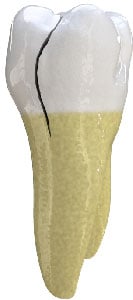
Cracked Tooth
A cracked tooth is an incomplete fracture that affects the chewing surface of the tooth and may extend down to the gum line and even to the root. It is necessary to detect these types of cracks early so that further damage can be prevented. Treatment will depend on the extensiveness of the crack, but a root canal procedure is often needed to restore the tooth.
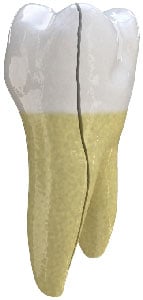
Split Tooth
If a cracked tooth is left untreated, it can progress to a split tooth. A split tooth involves a complete fracture from the crown down through the root. In this case, the tooth's dentin has separated into two distinct sections. Often, this condition progresses from a cracked tooth over time. If the fracture is severe enough, the tooth will need to be extracted.
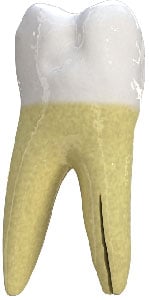
Vertical Root Fracture
This type of fracture starts at the root of the tooth and extends toward the crown. Typically, the patient will not experience symptoms until the fracture becomes severe. Treatment often requires extraction, but in some cases a portion of the tooth can be saved with endodontic surgery.
Treatment Options

How We Treat Cracked Teeth
- Crown: For fractured cusps and minor cracks, a crown holds the tooth together and prevents the crack from spreading
- Root canal + crown: When the crack has reached the pulp (nerve), root canal therapy removes the damaged tissue before a crown is placed
- Bonding: For minor surface cracks (craze lines) that are cosmetic rather than structural
- Extraction: When the tooth is split below the gum line or the crack extends deeply through the root
How to Prevent Cracked Teeth
- Don't chew on hard objects such as ice, unpopped popcorn kernels, pens, and hard candy
- If you grind or clench at night, ask Dr. Raffi about a night guard
- Wear a mouthguard during contact sports
- Don't use your teeth as tools (opening packages, tearing tape)
- Have large, old fillings evaluated, since they may need replacement with a crown for added protection
Today's small crack is tomorrow's big problem. Early treatment is the best way to save your tooth.
What to Expect at Your Visit
Visit Steps
- Symptom review: Dr. Raffi asks about the location, triggers, and pattern of your pain
- Clinical exam: Bite tests, percussion, and transillumination (shining a bright light through the tooth) to locate the crack
- Imaging: Digital X-rays and possible CBCT (3D) imaging to assess the depth and direction of the fracture
- Diagnosis: Dr. Raffi identifies the type of crack and explains the best treatment option
- Treatment: Many cracked teeth can be treated the same day, and the sooner that happens, the better the outcome
Helpful Tips
- If you can identify which side hurts, note it, but don't worry if you can't pinpoint the exact tooth
- Avoid chewing on the painful side until your visit
- Over-the-counter pain medication can help manage discomfort
- Craze lines (tiny surface cracks visible on front teeth) are very common and usually don't need treatment
- The earlier a crack is detected, the more treatment options are available. Don't wait for the pain to worsen
Frequently Asked Questions
No. Teeth are not like bone, which can knit itself back together. Once a tooth is cracked, the fracture is permanent, and the ordinary forces of biting and chewing tend to work it deeper over time rather than closing it up.
That is why a cracked tooth is worth acting on early. A crack that looks minor today can widen until it splits the tooth and leaves extraction as the only option. Catching it while the tooth can still be saved gives you far more treatment choices.
The on-again, off-again pain is the classic fingerprint of a cracked tooth. When you bite down, the crack flexes open for a moment and irritates the pulp, the nerve-rich tissue inside. As soon as you release the bite, the crack closes again and the sharp jolt fades.
Temperature sensitivity works along the same lines. The crack creates a pathway that lets hot and cold reach the nerve more directly than they would in a healthy tooth, so a hot drink or a cold bite can set it off.
Often, yes, though it depends on the type of crack and how far it reaches. Fractured cusps and many cracked teeth respond well to root canal therapy followed by a crown, which holds everything together. Split teeth and certain vertical root fractures, on the other hand, may be too far gone and need to come out.
The only way to know for sure is a close look. At our Chicago and Bourbonnais, IL offices, Dr. Raffi evaluates the crack with magnification and imaging, then walks you through the options that fit your particular tooth.
Usually not. Craze lines are the fine, shallow cracks that show up in the outer enamel, and they are extremely common in adults. Because they stay on the surface and don't reach the sensitive inner tooth, they rarely cause pain or need repair.
The main reason anyone treats them is appearance. If craze lines on your front teeth bother you cosmetically, options like veneers or bonding can cover them and refresh your smile.
Your molars and premolars do the heavy lifting when you chew, absorbing the strongest biting forces in your mouth with every meal. That constant load alone makes them more vulnerable than the front teeth.
Many back teeth also carry large fillings from past decay, and each filling replaces some of the natural structure that once made the tooth strong. Combine heavy forces with that reduced structure and you have the reason cracks tend to favor the back of the mouth.
A crack that goes untreated keeps spreading. Given enough time, bacteria find their way into the fracture and infect the pulp, which can lead to an abscess and considerable pain.
Left long enough, the tooth can split in two, and at that point extraction is usually the only remaining option. Treating a cracked tooth early, while it can still be saved, is always the easier and less costly path.
A crown is one of the most reliable ways to treat a cracked tooth. By capping the tooth completely, it binds the fractured structure together and keeps the crack from creeping any further under the pressure of chewing.
If the crack has already reached the nerve, root canal therapy comes first to remove the damaged pulp, and the crown goes on afterward. Dr. Raffi will determine whether a crown on its own will do the job or whether a root canal needs to happen first.
Tooth pain that comes and goes deserves a look. It may be a cracked tooth, so call us for an evaluation.
Visit Dr. Raffi General & Implant Dentistry
Chicago Office
6215 W Touhy Ave
Chicago, IL 60646
Bourbonnais Office
876 N Convent St
Bourbonnais, IL 60914